“If I have seen further, it is by standing on the shoulders of giants.”
— Sir Isaac Newton
This quote, written by Sir Isaac Newton in a letter in the 17th century, has followed me throughout my creative journey because it captures a truth many artists struggle to articulate: none of us create in a vacuum. Every piece we make is informed—consciously or not—by the artists who came before us. Studying other artists’ work is not only acceptable; it is essential to learning how to create, how to refine technique, and ultimately, how to find your own voice.
Why We Study Other Artists
When you are learning an art form, one of the most powerful tools you have is observation. Studying other people’s work allows you to understand what is possible within a medium. You learn techniques, tools, problem-solving approaches, and workflows that would take years to discover in isolation.
This study can happen in many ways: viewing work in galleries, attending shows, watching artists create in person, or following along with videos and classes. While online resources are invaluable, seeing art in person is irreplaceable. There is so much that cameras cannot capture—subtle textures, depth, layering, tool marks, and scale. Sometimes you need to get nose-to-nose with a piece to truly understand it.
Many people might consider this kind of close analysis boring, but if you know art, it makes perfect sense. You are not just looking—you are reading the work.
The Role of Copying in Learning
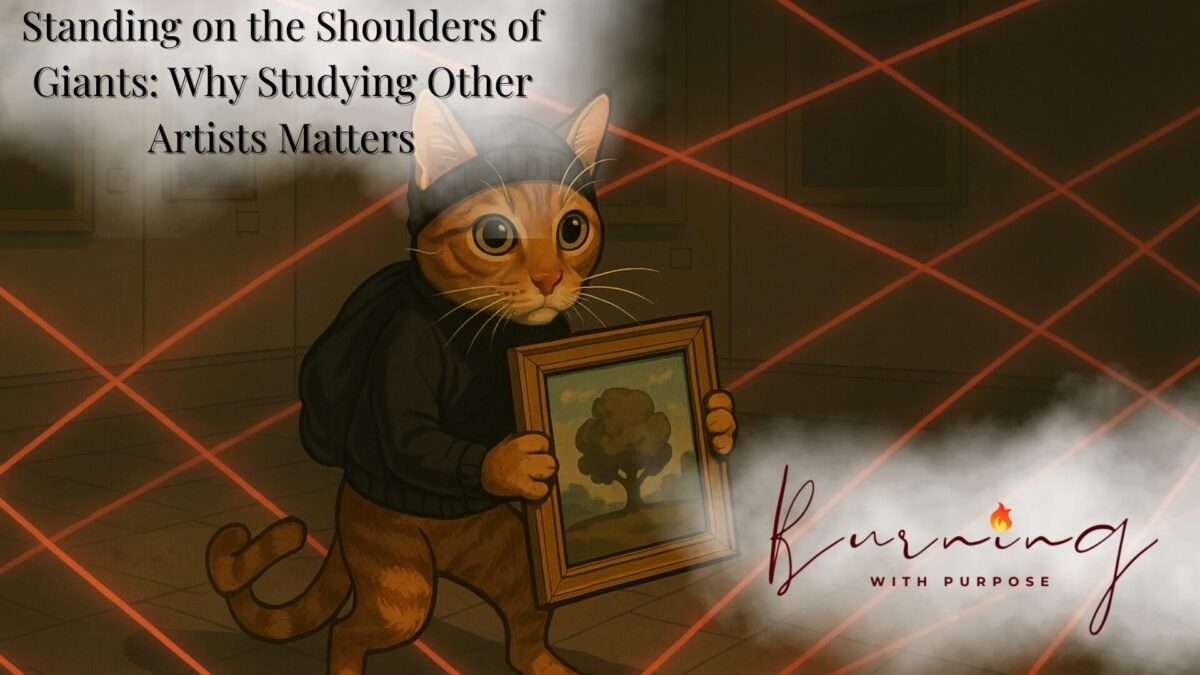
There is an uncomfortable word that often comes up in this discussion: stealing. But copying another artist’s work—without claiming it as your own—is one of the most effective ways to learn.
When you try to recreate something that already exists, you are forced to answer important questions:
- How was this made?
- What tools were used?
- How many layers are there?
- What order were techniques applied in?
Repeating these processes builds muscle memory. Over time, those movements, decisions, and patterns become second nature. This repetition allows you to carry those techniques forward and apply them in your own original work.
The distinction is intention. You are not copying to pass the work off as yours. You are copying to understand how it works.
Learning From Many Voices
It is important to study many different artists, not just one. Find a wide variety of creators whose styles speak to you and try to replicate elements of each. Every artist solves problems differently, and each approach has something to teach you.
Over time, you begin to merge these influences—along with your own instincts, experiences, and preferences—into something uniquely yours. All art is, in some way, an adaptation of what came before. Your style emerges not from avoiding influence, but from synthesizing it.
Who you are as an artist is reflected in who you choose to learn from.
Respecting the Lineage of Art
Studying other artists is also an act of respect. It acknowledges that the path you are walking was paved by others—by artists of past generations, your contemporaries, and your peers. We all study each other’s work, whether formally or informally.
There is a reason artists travel to museums like the Louvre to study masterworks up close. There is a reason apprenticeships, mentorships, and ateliers have existed for centuries. Learning directly from others—by asking questions, taking classes, reading the books they recommend, and even using similar tools—connects you to a larger creative lineage.
Observation in Practice
When I look at paintings or wood-burned pieces, I try to reverse-engineer them. How many colors were used? Was it layered or blended? What kind of brush or tool made that mark?
This kind of analysis fundamentally changed how I work. When I created Her Sovereignty, I built the color using layer upon layer of colored pencil—so many that most people cannot tell the medium at first glance. That technique came directly from studying other artists and paying close attention to how they achieved depth and richness.
Learning this way still blows my mind.
Finding Your Own Way
The goal of studying, copying, and analyzing is not to remain in someone else’s shadow. At some point, you find your own path forward. Your influences don’t disappear—they evolve. They become part of you.
We are not 100% unique, and that is not a flaw. We are composed of building blocks passed down through generations of artists. Our individuality lies in how we arrange those blocks.
Austin Kleon’s book Steal Like an Artist helped put language to things I was already doing. It validated the process and gave me a framework for following someone else’s lead without simply duplicating their work. It reinforced the idea that influence, when handled thoughtfully and ethically, is not theft—it is growth.
Final Thoughts
Studying other artists is not a shortcut or a weakness. It is how you learn to see, how you refine your craft, and how you discover your artistic identity. By standing on the shoulders of giants, you are not diminishing your originality—you are giving it a foundation strong enough to stand on its own.